
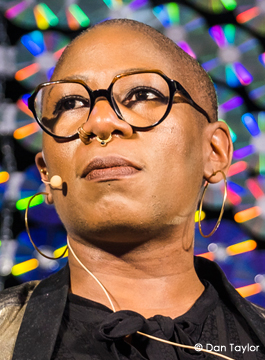
 Keynote Speakers
Ada Parris is a Forbes-recognised futurist, author, and influential voice on leadership, artificial intelligence, and the ethical challenges organisations face in a rapidly changing world.
As organisations have access to more data than ever, Ada challenges leaders to consider what is missing from the decisions that matter most.
While 96% of leaders expect AI to improve productivity, 77% of those using it report an increased workload.
Ada argues that this disconnect is not simply a technological problem, but a failure to listen, and one of the defining ethical challenges of our time.
Through her thought-provoking insights, Ada Parris highlights the voices, perspectives and human experiences that are too often overlooked. Rather than simply predicting the future, she helps organisations and leaders recognise, understand and respond to the changes already taking place around them.
Ada chairs Mental Health First Aid England, an organisation that has trained over one million people, and is the author of Leadership Legacy (Wiley, 2026).
She also serves as Co-Deputy Chair of the IEEE AI Systems Global Flourishing Initiative and is a member of the WWF Innovation Wisdom Council.
Her influence across technology, leadership, and social innovation has earned her widespread recognition, including seven longlistings for Computer Weekly’s Most Influential Women in UK Tech.
She is also a Fellow of the Royal Society of Arts (FRSA) and an Honorary Fellow of Arts University Plymouth.
Combining expertise in emerging technologies with a deep understanding of human behaviour, ethics and organisational change, Ada offers a distinctive perspective on the future of leadership. Her work encourages organisations to look beyond technological advancement and focus on the people, values and decisions that will ultimately shape a more responsible and successful future.
Why Book Ada Parris:
Your experts have the AI strategy. Your consultants have the roadmap. Ada is who you bring in when the room needs to think differently, not just move faster.
Most AI ethics asks how to make the machine behave. Ada asks who was listened to before it was built.
She is a futurist and an artist. Her research moves through soil, DNA, 1899 colonial maps and her own brain scans. The art is the evidence. It makes the listening crisis something an audience can feel.
“One of the most important futurists in the world”
Forbes Brazil
Signature Keynotes:
We’re Not In a Technology Crisis. We’re in a Listening Crisis.
Leaders expect AI to make their people faster. Their people say it has made the work heavier. That gap is costing billions, and better data will not close it.
Ada names what is being left out, and what changes when a room listens to body, soil, ancestral memory and the algorithm at once.
Takeaways: Why the AI productivity gap is a listening gap · The Four Intelligences · A shared language teams keep using.
Who it’s for: C-suite and boards · AI transformation summits · Strategy and innovation leaders.
Ethics Starts Upstream: Who Was Asked Before It Was Built?
Most AI ethics asks how to make the machine behave. This talk asks who was listened to first. Who defined fair? Were they asked? Should their knowledge enter the system at
all? Drawing on Global Majority and Indigenous ways of knowing, Ada shows why consent comes before code.
Takeaways: The upstream questions AI ethics skips · Consent and knowledge sovereignty as design choices · Guardrails built on reciprocity, not control
Who it’s for: Responsible AI and governance teams · Tech and policy forums · Universities · Global organisations deploying AI.
Cartography Is Not Home: AI and the Logic of the Map
Maps decided what counted. Whatever they left off stopped existing on paper. AI is doing the same at scale. Working with original 1899 Times Atlas pages, Ada traces how colonial map logic lives on in the data we train on. Available as a talk or an immersive, sound-based experience.
Takeaways: How inherited assumptions travel into AI · Questions to ask of any dataset · Why who is missing from your data is missing from your future
Who it’s for: Data and technology leaders · Cultural institutions · Arts and innovation festivals · International organisations.
Power That Doesn’t Exhaust Itself: The Hidden Cost of Not Listening
Poor mental health costs UK employers £51 billion a year. The biggest share is presenteeism: people at work, but not heard. This is not a wellbeing problem to hand to HR. It is where AI investment leaks away. Drawing on her own leadership and lived experience, Ada shows what presence makes possible instead.
Takeaways: Why burnout is an innovation risk · Where unheard people show up on the balance sheet · Authority others can organise around
Who it’s for: CEOs and executive teams · Financial and professional services · Health sector leadership · Organisations scaling AI.
What Type of Ancestor Do You Want to Be?
This question stops executives mid-sentence. It moves leadership from reputation to legacy: the conditions you leave for those who come after. Drawn from Ada’s Wiley book, Leadership Legacy, it gives weight to a knowing most leaders already carry.
Takeaways: A shared language for long-term consequence · One governing question for every decision · Legacy as strategy, not sentiment.
Who it’s for: Board retreats · Leadership programmes · Impact investors · Sustainability and ESG leaders.